

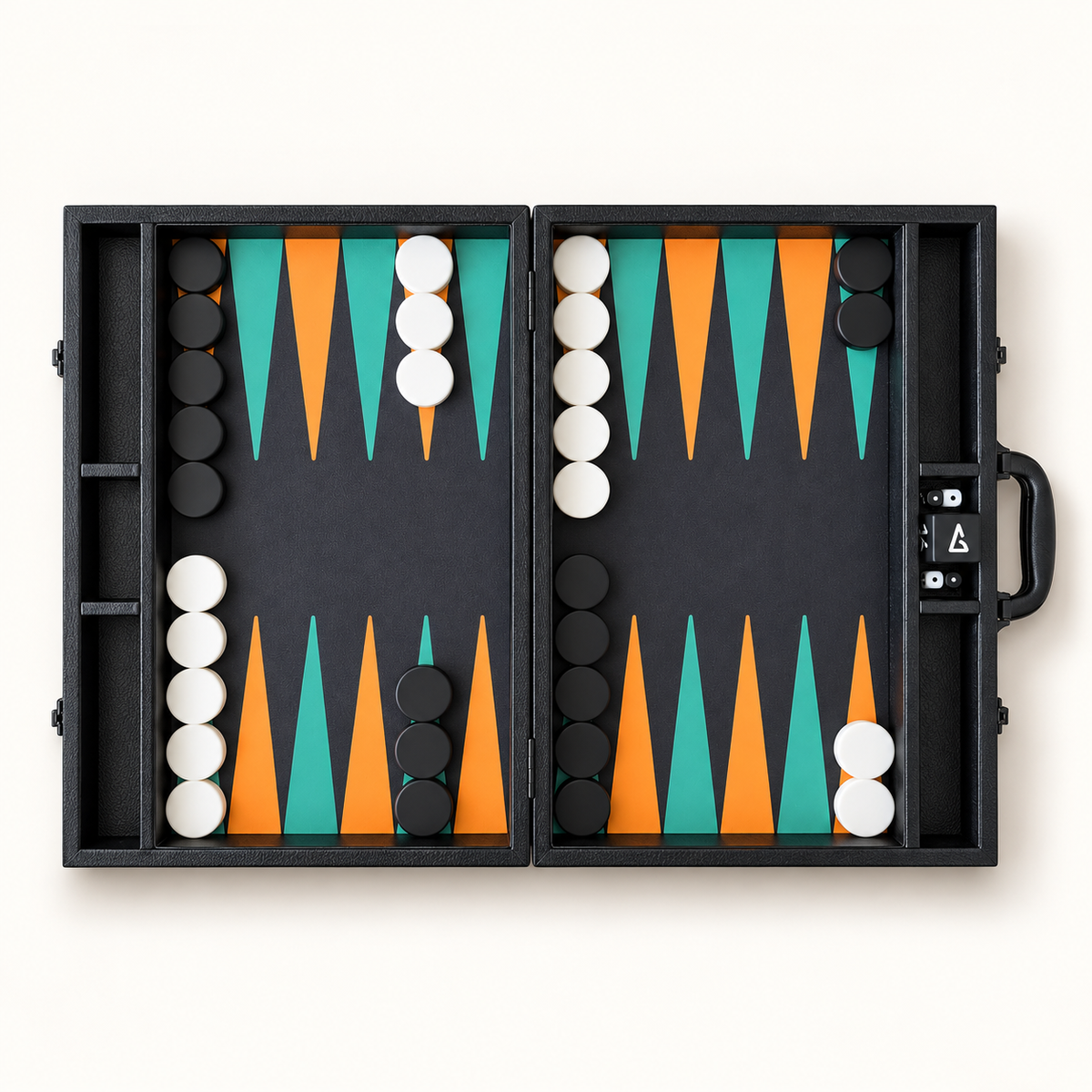
The best high-end backgammon board depends on how you play. For tournament play, Backgammon Galaxy's Nova, Earth and Monte Carlo boards and FM Gammon's handcrafted sets are built around match specifications. Geoffrey Parker and Alexandra Llewellyn make bespoke boards to order. Crisloid makes the long-standing cork workhorse.
Galaxy's own range starts with tournament-size Nova boards and runs up to its flagship Earth and Monte Carlo boards. Galaxy also stocks FM Gammon's handmade tournament boards.
Prices in USD, checked on 2 October 2026. Prices, styles and availability can change. This guide is published by Backgammon Galaxy, which sells its own boards and selected FM Gammon sets.
What Makes a Backgammon Board Truly High End?
A high-end backgammon board is one that performs well in actual play, not just one that costs a lot.
The U.S. Backgammon Federation's rules for in-person play set a clear baseline. Where the equipment is available, a player may require a board designed for checkers between 37 and 50 mm in diameter, and may require lipped dice cups or precision dice. So at a USBGF event, an expensive board outside that range can be swapped out if your opponent asks and a board in range is available.
Checker scale is the most visible signal. According to the New England Backgammon Club's buying guide, 1.75-inch (44.5 mm) checkers are overwhelmingly popular in American tournament play. Most sets built for them give a comfortable reach to every corner, and the size lets a player take in the whole position at a glance.
Dice and cups come next. Traditional pitted dice have a different amount of material drilled from each face, so the faces are not evenly weighted, and NEBC notes that precision dice are strongly preferred in competition. Lipped cups are officially preferred in most tournaments because the lip makes it harder to slide the dice out without a true roll. The last test is wear: whether the surface still plays well after hundreds or thousands of games.
An expensive board can fail every one of these tests and still look beautiful. Knowing whether you are buying a playing instrument or a display object is the first decision any four-figure purchase requires.
Comparison Table: Which Premium Board Fits Which Type of Buyer?
No single board suits every buyer, so start with how you play.
| Board range | Ideal buyer | Style of luxury | Tournament-ready signals | Surfaces and customization | What to ask before buying |
|---|---|---|---|---|---|
| Galaxy Nova Board | Tournament player who wants full size at an accessible price | Player-designed, modern | Tournament size, 30 checkers at 44.3 mm, matte doubling cube, two cups | Galaxy colorways; check the current collection | Confirm the exact style, frame color and included equipment |
| Galaxy Earth and Monte Carlo Boards | Serious player who wants a flagship tournament board | Architectural (Earth) or 1970s vintage styling (Monte Carlo) | Tournament size; Earth is laid out to the same dimensions as the online Galaxy board | Removable playing surfaces, swappable Galaxy styles | Whether you want the Earth tray box for travel or the Monte Carlo padded case |
| FM Gammon (sold by Galaxy) | Tournament-performance buyer who prefers handcrafted hardwood | Handcrafted hardwood | Precision dice and 30 checkers included, MagFit interchangeable surfaces | MagFit options; confirm inlay compatibility for the exact model | Packed weight if you travel with it |
| Geoffrey Parker | Bespoke-leather traditionalist | Handmade English leatherwork | Calf-leather field; precision dice with the Competition and Tournament sizes | Wide color and size choice | Whether the field can be replaced when it wears |
| Crisloid | Everyday and club player | Cork boards made in Providence, Rhode Island | Cork field; felt on the Pro Series | Color, logo and monogram options | How the cork will hold up under weekly play |
| Alexandra Llewellyn | Commission-art collector | Biographical marquetry and photographic inlay | Confirm specifications for the chosen commission | Fully bespoke commissions | How the chosen materials suit your intended frequency of play |
| Manopoulos | Buyer who wants handcrafted wood at a lower price | Greek marquetry veneer | Tournament editions available | Style range across price points | Checker size and field specs for the exact model |

Material Tradeoffs: Why the Playing Surface Matters More Than the Logo
The playing field is the most important part of any backgammon board. Dice need to tumble on it, not skid, and checkers need to slide without catching.
Dense wool is a strong option for serious play. The New England Backgammon Club says wool sets tend to give an ideal dice tumble, let checkers glide with ease and wear for a very long time. Synthetic surfaces vary too much between makers to judge as a group, so test the one you are considering.
Cork was the standard surface for decades, and it is still one of the most sensible: inexpensive, stain-resistant and easy to clean, with enough traction for the dice. It wears out with frequent use. Crisloid will resurface a worn board, though NEBC notes that a new set can be the more economical fix.
Leather is the most variable. Flat leather sometimes makes checkers slide poorly, so players end up lifting them. Geoffrey Parker's pebble-textured leather is the exception NEBC singles out, because it works well with the brand's metal-rimmed checkers. Try the slide before you buy.
Wood is out of favor in competitive backgammon. Dice tend to skid on it rather than tumble, it can be a little noisy, and on hard surfaces a die can spin like a top for a tedious length of time.
Before buying any premium board in person, run this quick check:
- Slide a checker across the points to the far corner: does it glide, or catch on the edge of a point?
- Roll two dice from the cup: do they bounce and tumble, or skid flat?
- Press lightly on the center of the field: is there any spring or flex in the surface?
- Rattle the cup and listen to the dice land: is the sound tolerable for a two-hour match?
- Stack five checkers on one point: the fifth should nearly, or only just, cover the tip.
Use these checks to compare how each board feels in play; they are a buying checklist, not a tournament certification.
Brand-by-Brand Verdicts for Serious Buyers
Backgammon Galaxy Nova: full tournament size at $400
Galaxy designs its boards around the game rather than the case. The Nova Board is a full tournament-size set listed at $400 for the X-22 style, with 30 checkers at 44.3 mm, four dice, two cups and a matte doubling cube. That checker size sits inside the USBGF range and 0.2 mm off the 44.5 mm American tournament favorite. Check the current collection for other Nova styles and availability.
Backgammon Galaxy Earth and Monte Carlo: flagship boards
Above Nova sit the flagships. The Earth Board lists at $1,150 and is laid out to the same dimensions as the board on Galaxy's online platform, so players who study there already know its geometry. Galaxy also cut the reach to checkers on the opponent's side, and the two bear-off trays combine into a separate tray box that packs inside the board. The Monte Carlo Board costs $1,250 and revives the look of 1970s backgammon sets, with smoky-swirl checkers, faux-leather case padding and a handle. Both use removable playing surfaces, so a worn or unwanted field is a swap rather than a new board.


FM Gammon: handcrafted hardwood and tournament equipment
FM Gammon suits players who want handcrafted hardwood and tournament performance. Galaxy lists FM Gammon tournament boards, including the American Cherry board at $2,400, whose listed accessories include precision dice, 30 checkers, a scoreboard and a leather carrying bag. FM Gammon's MagFit system makes the surfaces interchangeable, but confirm the exact model and replacement-inlay compatibility before ordering.

Geoffrey Parker: bespoke English leatherwork
Geoffrey Parker is the traditional English bespoke-leather maker. Each board is handmade to order in England with a calf-leather field, and precision dice come with its Competition and Tournament sizes.
Alexandra Llewellyn: commissioned artwork and marquetry
Alexandra Llewellyn makes commissioned art boards in biographical marquetry and photographic inlay. The main distinction is bespoke artwork and personal storytelling. Confirm playing dimensions and equipment for the commission you choose.
Crisloid: cork workhorses and felt alternatives
Crisloid boards are made in Providence, Rhode Island, and the New England Backgammon Club calls them long-standing workhorses. Its Pro Series models use felt for players who prefer a fabric field.
Manopoulos: Greek wood marquetry
Manopoulos has made handcrafted wood marquetry boards in Greece since 1970, at more accessible prices than the bespoke makers. Tournament editions exist, but buyers should verify checker size and field specs per model.
For a handmade leather heirloom, a bespoke maker is the natural route. Ask it the two questions Galaxy's product pages answer: what checker size does it use, and can the field be replaced?
Before You Spend Four Figures: The Ownership Questions That Matter
Purchase price is one number. Ownership cost is another, and the gap between them is where buyers get caught out.
Start with serviceability. Galaxy's Earth and Monte Carlo boards use removable playing surfaces, and replacement Galaxy surface sets start at $135. FM Gammon's MagFit boards swap surfaces the same way, and Crisloid will resurface its cork boards. A board with no replacement-field option is not necessarily the better long-term investment, however much more it costs.
Weight deserves more attention than it gets. A full tournament board is heavy: Galaxy's board buying guide lists the Nova at 4.7 kg complete and the Earth Board at 4.14 kg. If you travel to tournaments, look for a board designed for travel. Leaving the Earth's tray box at home brings the board down to 2.14 kg, with the checkers, dice and cube carried in the zip bag instead.
Customs and shipping implications are real for international orders. A board shipped across a border can attract import duties and longer lead times, so ask for the landed price before you order. A custom-order board with strict non-refund terms adds financial risk if the final product does not meet playing expectations.
For an expensive board, the New England Backgammon Club recommends going to a major tournament first, where most of these boards can be seen in play. Check far-corner reach, checker spacing, dice action, cup comfort, noise and packed transport weight in person.
The practical pre-purchase checklist:
- Confirm replacement-field or resurfacing availability from the manufacturer
- Ask for packed weight including the travel bag
- Check customs duty estimates for your country on the final landed price
- Verify checker diameter against the 37-50 mm USBGF range
- Understand the custom-order refund and cancellation policy before paying
For Galaxy's boards compared side by side on size, weight and playing surface, see the board buying guide. Browse Galaxy's tournament boards to compare every Nova, Earth and Monte Carlo style.
Frequently Asked Questions
What Is the Best High-End Backgammon Brand Overall?
There is no single winner for every buyer. For tournament play, Galaxy makes player-designed boards including the $400 Nova X-22, $1,150 Earth and $1,250 Monte Carlo boards, and it also sells FM Gammon's handcrafted tournament boards. Geoffrey Parker is the traditional bespoke-leather maker, Alexandra Llewellyn makes commissioned art boards, and Crisloid makes cork boards in Providence, Rhode Island.
Is There a Tournament-Size Backgammon Board Under $500?
Yes. The Galaxy Nova Board is tournament size and lists at $400 for the X-22 style. The X-22 set comes with 44.3 mm checkers, a matte doubling cube, two cups and four dice.
Is Every Luxury Backgammon Board Suitable for Tournaments?
No. The USBGF's in-person play rules let either player insist on tournament-grade equipment when it is on hand: a board built for 37-50 mm checkers, lipped cups and precision dice. Some expensive boards are built for display first. Checking field behavior, checker scale, dice and cups before buying is the only reliable way to confirm a board will serve in tournaments.
What Size Should a High-End Tournament Board Use?
Pick a board built for checkers of 37-50 mm, the range in USBGF rules. The New England Backgammon Club reports that 1.75-inch checkers, about 44.5 mm, dominate American tournaments because they keep every corner within easy reach.
Which Playing-Surface Material Is Best for Serious Play?
Dense wool and well-designed fabric fields are strong options for checker glide and dice action. No material is universally best; test the exact surface. Cork is inexpensive, stain-resistant and easy to clean but wears out with frequent use. Leather varies by finish, so test the checker slide. Wood is out of favor in competitive play because dice tend to skid on it.
Should I Try a Premium Backgammon Board Before Buying One?
Yes, especially above $1,000. The New England Backgammon Club says the best place to shop for an expensive board is a major tournament, where you can watch most premium boards in play. Reach, checker glide, dice action, cup feel, noise and packed weight only show up properly in person.
References
- New England Backgammon Club. "Backgammon Sets." https://nebackgammon.org/index.php/backgammon-sets/ (accessed 2 October 2026).
- U.S. Backgammon Federation. "Rules for In-Person Play." https://usbgf.org/tournament-rules/rules-for-in-person-play/ (accessed 2 October 2026).
- Backgammon Galaxy. "Nova Board - X-22, Tournament Backgammon Set." https://shop.backgammongalaxy.com/products/new-bestselling-board-x22-style (accessed 2 October 2026).
- Backgammon Galaxy. "The Earth Board, Size: Tournament." https://shop.backgammongalaxy.com/products/earth-luxury-backgammon-board (accessed 2 October 2026).
- Backgammon Galaxy. "Monte Carlo Board, Size: Tournament." https://shop.backgammongalaxy.com/products/monte-carlo-grand-prix-board-luxury-backgammon-set-classic (accessed 2 October 2026).
- Backgammon Galaxy. "Earth or Void Board Inlay Set (MagFit system)." https://shop.backgammongalaxy.com/products/board-surface-set-magfit-system (accessed 2 October 2026).
- Backgammon Galaxy. "FM Gammon - American Cherry, Size: Tournament." https://shop.backgammongalaxy.com/products/american-cherry-luxury-backgammon-set-fm-gammon (accessed 2 October 2026).
- Backgammon Galaxy. "All Backgammon Sets." https://shop.backgammongalaxy.com/collections/all-backgammon-sets (accessed 2 October 2026).
- Backgammon Galaxy. "The Ultimate Guide to Buying the Right Backgammon Board (Updated 2026)." https://shop.backgammongalaxy.com/blogs/news/the-ultimate-guide-to-buying-the-right-backgammon-board (accessed 2 October 2026).
- Geoffrey Parker: Leather Backgammon Set (accessed 2 October 2026).
- Alexandra Llewellyn: Private Commissions (accessed 2 October 2026).
- Crisloid: Felt Backgammon Sets (accessed 2 October 2026).
- Manopoulos: History (accessed 2 October 2026).
Share:
What is Backgammon Precision Dice?
Best Value Backgammon Board: What to Buy in 2026