

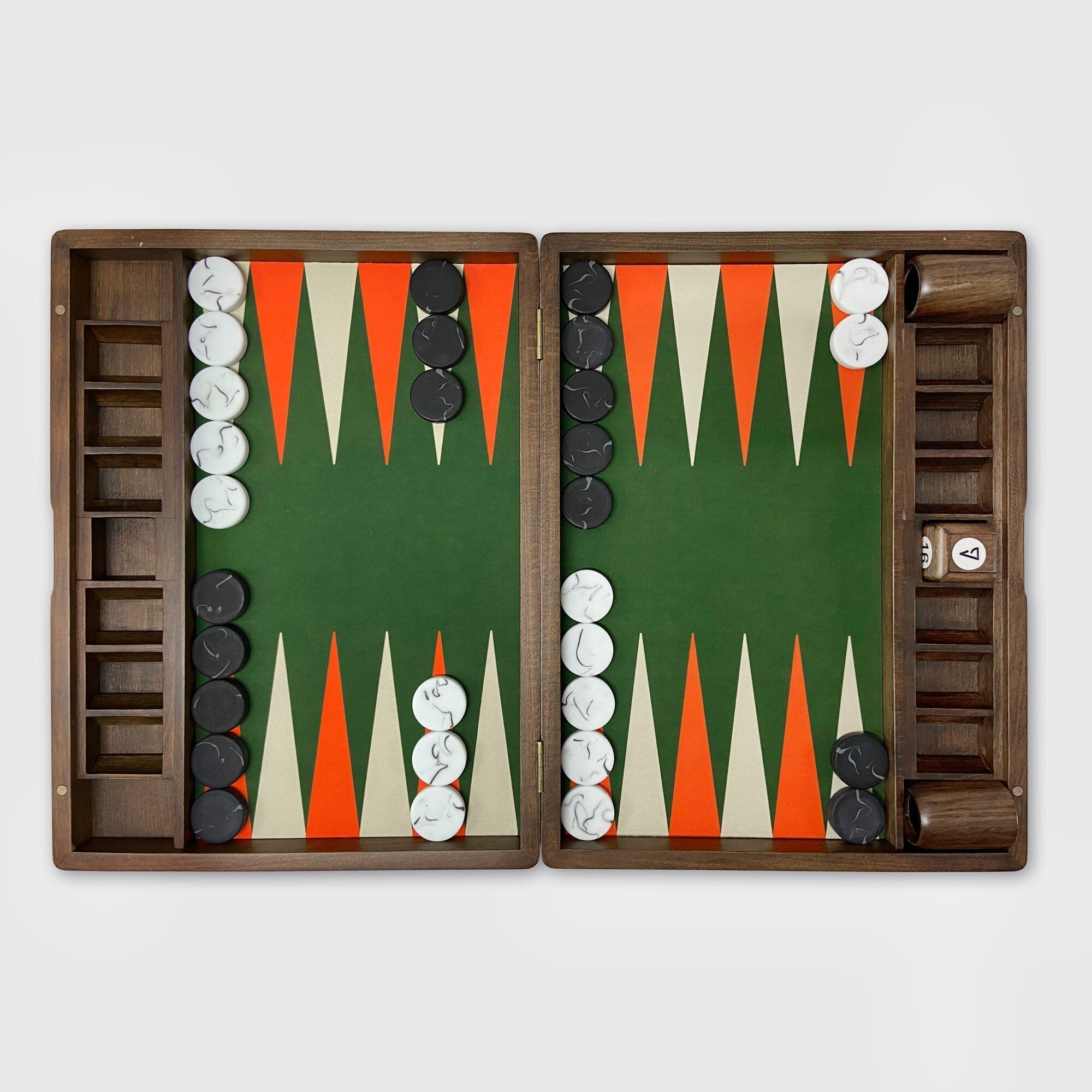
How to Choose the Best Backgammon Board?
Unless you’re a veteran in the backgammon world you may be totally overwhelmed by the many different types of backgammon sets in the market.
This guide will lead you painlessly through all the options and you’ll be able to figure out what kind of board is right for you.
Quick comparison: which Backgammon Galaxy board fits you?
If you already know roughly what you need, start here. Prices and availability below were checked on September 22, 2026 and can change. Dimensions and weights come from current product data; where a specification is not published, we say so rather than estimate.
| Product family | Current price | Dimensions | Weight | Playing surface | Included equipment | Intended buyer |
|---|---|---|---|---|---|---|
| Daily | $99 | Medium-sized folding board; exact dimensions are not published in the current product data | Not published | Felt interior in a leatherette folding case | 30 × 35 mm checkers, 2 leatherette dice cups, dice, doubling cube | Casual and everyday players who want a reliable board at the lowest price in the current range |
| Nova | $400 | Open: 74 × 51.5 cm (29.1 × 20.3 in). Closed width: 36.5 cm; closed depth: 8 cm. | 4.7 kg / 10.36 lb complete | Fixed playing surface; full tournament proportions | 30 large checkers, 4 dice, 2 dice cups, matte doubling cube | Serious and tournament players who want full-size play at a much more accessible price |
| Earth | From $1,150; current Earth 2.0 styles are generally $1,250 | Tournament size. Board height: 3.8 cm open / 7.6 cm closed. Full footprint is shown on the product measurement image. | 4.14 kg / 9.13 lb complete; 2.14 kg without tray box | Removable MagFit felt-on-silicone surface | Removable playing surfaces, wooden + lightweight checker trays, cube, 2 cups, finger-dish checkers, carry bag | Premium buyers who want tournament play plus a flexible separate-tray design and swappable surfaces |
| Monte Carlo | $1,250 | Tournament size; the current listing states the playing dimensions are consistent with the Earth family | Not stated on the current product page | Removable premium playing surface | Removable playing surfaces, checker set, doubling cube, 2 cups, carry bag | Premium buyers who want a traditional tournament case with a deliberately vintage Monte Carlo aesthetic |
| Adventure | From $650 | Open: 48 × 42 × 3.57 cm. Closed: 24 × 42 × 7.5 cm. | Approx. 3 kg listed | Compact felt travel surface | Cube, 2 cups, checker box, 30 checkers, carry bag | Travelers who want the smallest rigid premium board and a separate checker box |
| Adventure+ | $850 | Open: 67 × 42 × 3.57 cm. Closed: 33.5 × 42 × 7.5 cm. | Approx. 2.75 kg listed | Fixed felt travel surface with integrated checker trays | Cube, 2 cups, 30 checkers, carry bag, 2 precision dice pairs | Travelers who prefer a more traditional self-contained case and more playing room than Adventure |
| Atlas | $300 when available | Tournament-size roll-up; exact footprint is not stated on the current listing | Approx. 1 kg listed | Sturdy vegan-leather roll-up surface | Matte 44.5 mm checkers, dice and doubling cube | Players who prioritize minimum carrying weight while keeping tournament-size checkers and playing area |
Our current board recommendations — and the trade-offs
Daily: the affordable everyday board

Daily is the simplest entry point in the current range. At $99, it is a medium-sized folding board with 35 mm checkers and everything needed to play. It is designed for regular casual games rather than for buyers specifically chasing tournament-size proportions or premium materials.
Choose Daily if: you want a dependable board for home, friends, cafés or casual travel and price is your biggest consideration. Choose something else if: you want 44+ mm checkers, tournament-size proportions, solid-oak construction or replaceable playing surfaces.
Availability: the Daily product is active, but current inventory is at zero, so check the product page for incoming stock.
Nova: the accessible tournament option

Nova fills the gap between everyday boards and four-figure premium tournament sets. At $400, it gives serious players a full tournament-size board with large checkers while keeping the construction and price much simpler than Earth or Monte Carlo.
Choose Nova if: you want a proper tournament-size setup for regular club, café, home or event play and you prefer spending on the playing experience rather than premium woodwork or interchangeable surfaces. Choose something else if: you specifically want MagFit/removable inlays, premium oak construction, or a genuinely compact travel board.
View the Nova X-22 tournament board →
Earth and Monte Carlo: premium tournament boards
Earth

Monte Carlo

Earth and Monte Carlo are for buyers who want more than tournament dimensions. The premium goes into materials, construction, presentation and replaceable playing surfaces. Earth is the more flexible design: its separate tray box can be positioned independently or left at home to reduce carrying weight. Monte Carlo is the more traditional choice, with a classic case format and a deliberately vintage color language.
Choose Earth if: you value the separate tray system, removable MagFit surface and the option to strip the setup down for travel. Choose Monte Carlo if: you want a traditional premium tournament case with the classic Monte Carlo look. Choose Nova instead if: tournament-size play matters more to you than premium materials and swappable surfaces.
View the Earth tournament board →
View the Monte Carlo tournament board →
Adventure vs. Adventure+: two different travel priorities
Adventure

Adventure+

Adventure is the more compact rigid travel board: its open footprint is 48 × 42 cm and the separate checker box helps keep the case itself small. Adventure+ opens to 67 × 42 cm and uses integrated checker trays, so it feels more like a conventional backgammon case while still being much easier to travel with than a full tournament board.
Choose Adventure if: minimum suitcase space and a lower price matter most. Choose Adventure+ if: you want more playing room and fixed checker trays in a self-contained case. Choose Nova instead if: you can accept more weight and bulk in exchange for full tournament-size checkers and proportions.
View the Adventure travel board →
View the Adventure+ travel board →
Atlas: tournament size with roll-up portability

Atlas approaches portability from the opposite direction. Instead of shrinking the playing experience, it keeps a tournament-size concept and 44.5 mm checkers but removes most of the rigid case weight. At roughly 1 kg listed, it is a compelling option for someone who wants a large board that is easy to carry.
Choose Atlas if: carrying weight is your biggest constraint and you are comfortable with a roll-up format. Choose something else if: you want a rigid frame, integrated trays, or the presentation of a traditional case. Current inventory is exhausted, so check the product page for availability.
Deep Dive Guide: What Makes a Backgammon Board Good?
If you want to go beyond the quick product comparison, the rest of this guide breaks down the individual elements that shape how a backgammon board looks, feels and plays — including size, checkers, playing surfaces, case construction, hinges, colors and materials.
1. Your use case![]()

There are many use cases for backgammon sets one of which is tournaments.
Firstly, what do you want to use the board for? The common uses are:
- Friend- or family gatherings
- Vacation or travelling
- Tournaments
- Chouettes (this is what a money session with many participants is called)
- A mix
Other uses:
- Centerpiece home decoration
- Impressing others
If you’re playing mainly at the occasional family gathering it may not be worth it for you to get a high-end board. Just take it easy with the cheap option!
If you want to take the board on the go you should consider something that fits inside a backpack.
However, if you’re interested in the world of tournament backgammon or playing seriously with friends, it will hardly be worth it in the long run to choose anything other than a nice higher end board.
The special kicker is if you care a lot about your home decoration then it may not matter what your other uses are. Many folks get great pleasure from using a nicely designed backgammon board as a centerpiece in their living room or game room.
Browse by collection and find your ideal board →

2. How often will you use it?
You need to ask yourself the question if you will likely use the board only once or twice a year or many times. The more you plan on using your board you’re better off not settling for the cheapest option.
3. Size
Backgammon boards come in many sizes and are often denoted in how many inches they are from top to bottom:
- small (roll-up boards, >12-16 inches)
- medium (16-19 inches)
- tournament (19 inches <)
Browse by size and find your ideal board →
 The most important factor regarding size is how it impacts the “feel” of playing. If you have a small board with small checkers then it doesn’t feel as nice to shuffle, lift or move checkers around - there’s just not enough heft in the pieces.
However, a drawdown of really big backgammon boards is that they can be heavy to bring around and sometimes so large it can be a bit difficult to get a good overview when playing.

4. Checkers
Checker size
- Small: less than 38 mm / 1.5”
- Medium: 38 mm / 1.5”
- Large: 44.5 mm / 1.75”, sometimes you will even see 50 mm
- Note: (38mm = 1.5”, 44.5mm = 1.75”)
Let’s talk about “feel” again. You can get a decent feel with 38 mm checkers - not wonderful, but not bad. With 44.5 mm you’ll get a REALLY nice feeling when playing.
With anything less than 38 mm you’re still playing backgammon, but there’s no chance of feeling the addictive sense of moving checkers.
Check out our Checkers Collection →

Checker styles
Checkers are the gemstones of the backgammon set. They can breathe a lot of style and personality into a set. What are the options in the market?
- Plain (uniform color)
- Marbelized plastic
- Metal rim checkers


Shape
- Regular
- Fingerdish (indentation in the checker)
Material
- Wood
- Plastic
As you can see there are many options, but the choice is not as difficult as it may seem. Wooden checkers can be attractive, but they are usually lighter and show wear differently from acrylic or resin. If you want the heavier, smoother feel common in serious tournament-style sets, acrylic or resin is often the safer choice.
Secondly, most backgammon sets come with regular plain plastic checkers unless you’re buying a more expensive board. They can be just fine if the size is right.
The fun begins when you’re buying special checkers. Then it mostly comes down to taste and finding the marble effect you like! Each checker will have its own “fingerprint” due to the production method.
Metal rim checkers are mostly used when the styling material is something that cannot be fashioned into a checker piece, so that the rim is needed to hold and protect the material. Metal rims also add a whole ton of weight so they’re not good to use in travel sets, but can be extremely pleasing to the eye.
5. Surface
The surface material may be the most important aspect of the board since it is the most visual part of the board. It will also completely determine the “feel” when playing.
- Felt - Checkers glide smoothly
- Leather - Robust feel, but not smooth
- Wool - Robust feel, and smooth
- Cork - Vintage look and robust, but not smooth
- Wood - Looks good, but is very noisy (you will regret this option)


For frequent serious play, quiet fabric surfaces such as felt, wool and similar textiles are popular because they combine checker glide with controlled dice noise. Leather, cork and wood have different tactile qualities; wood is typically much louder, so consider both your playing environment and the rules of any organized event you plan to attend.
There is no universal best surface. Prioritize controlled checker glide, comfortable dice noise, durability, and whether you value a surface that can be cleaned or replaced.
MagFit surface
FM Gammon and Backgammon Galaxy sell the MagFit solution where the playing surfaces can be changed easily. It’s a nice feature you should consider. There are really no down sides, though it is only an option for high-end boards.

6. The Case
The two common materials that are used are:
- Wood
- Leather or imitation leather

There are a few determining factors when choosing the right case material:
- The look
- Scratch resistance
- Sound
Firstly, the look of natural wood is a big point of attraction for many buyers. A beautiful piece of wood with a good shine that accentuates the grain can’t be beaten in terms of looks! However, this is not something you can find in a cheap board, and it is more prone to scratches. This is also why most boards, even cheap and expensive boards, come with either leather or imitation leather. With the leather option you don’t have to worry about scratches, but it comes at the cost of beauty.
Another important aspect of wood is the amazing feel and sound you get when the checkers or dice hit the frame when playing. Please note this is only nice when the surface is not also wooden, because then it becomes too much.
When choosing the case material there are no pitfalls and it comes down to taste.
7. Hinges
The board will either have the hinges on the inside or the outside. Sometimes for high end boards the hinges will be hidden with a piece of leather.
Usually inner hinges are used for wooden cases so the outside case shows the wood in an undisturbed way.
There really is no right or wrong, but consider if the hinge color complements the main color swatch of the board.
8. Color swatch
Be sure to pick a board where the colors of the case, points, and surface are complementary with a balanced contrast.

You will be surprised how often you will find color swatches that are not very pleasant. This is because many makers of boards are good at production, while having less of an eye for visual design.
If you are unsure of what color you like it helps to see a board in real life. Photos can sometimes be deceiving so if you have the chance to see a board in a shop before buying, this is advised.
How does price change the playing experience?
A lower-priced board can play perfectly good backgammon. What you generally gain as you spend more is not a different game, but better materials, larger or heavier checkers, a quieter and smoother playing surface, sturdier hardware and case construction, better trays and accessories, tighter quality control, and—in some premium boards—replaceable playing surfaces.
The most important question is whether you are paying for features you will actually notice. A serious player on a budget may get more value from tournament dimensions and large checkers than from premium woodwork. A frequent traveler may value lower weight more than a full-size case. A premium buyer may care about materials, presentation and long-term serviceability.

With Backgammon Galaxy boards, experience the full thrill of the game →
Price
Price should follow your use case rather than define it. Current board pricing spans a very wide range, and the useful question is what the extra money buys you.
- Under roughly $200: mainly casual, beginner and everyday sets. The Daily Board sits here at $99; check checker size, surface and case construction rather than price alone.
- Roughly $250–$500: an important value zone for serious players. Full tournament-style options exist here, including Nova at $400.
- Roughly $600–$900: premium travel boards and more specialized construction, including Adventure and Adventure+.
- $1,000+: premium tournament boards where materials, construction, replaceable surfaces, finish and presentation become a larger part of the value.
For many serious players, the best value is the lowest-priced board that gives them the size, checker feel, surface and portability they actually want.
Buying a Used Backgammon Board
If you want a good starter board, but really struggle with price you can very often find some fine used sets listed online. Most often you’ll find the used boards are still in excellent condition!
We can recommend Ebay, Facebook Marketplace or the Facebook group “Backgammon Marketplace”.
Other backgammon board makers worth comparing
No single maker is the right choice for every player. If you are comparing premium boards, established names such as FM Gammon, Geoffrey Parker and Gammoner offer different approaches to materials, construction, customization and design.
For serious players watching the budget, Nova now belongs in the comparison because it is a current $400 tournament-size option from Backgammon Galaxy. External alternatives are still useful benchmarks:
- Wycliffe Brothers: current Gen III tournament sets use a 21-inch format, V-Fiber playing surface and 44.5 mm checkers. They are a relevant direct comparison if tournament proportions and value are your priority.
- Silverman & Co.: 19-inch traditional suitcase-style sets are commonly sold through third-party retailers. They can be a useful lower-price comparison, but check the exact model, surface, checker size, seller warranty and shipping terms because listings vary.
- Crisloid: its current Signature range includes tournament-sized attaché sets with a distinct, more traditional design and material approach. It is worth comparing if that style appeals to you.
Rather than treating these brands as a quality ranking, compare the exact board you are considering: playing surface, checker size and weight, overall dimensions, portability, included accessories, replacement parts, warranty, shipping and current availability.
Conclusion
We have gone through all the most important elements of the backgammon board. You should now be more aware of all the possibilities when you browse the market.
Review of the Backgammon Galaxy Earth board
If you enjoyed this article you can read about our “Earth” board that we developed using all our experience and knowledge about backgammon boards:

Share:
Review of the Backgammon Galaxy “Earth” Backgammon Set
Book Coming Soon: The Zizka Method